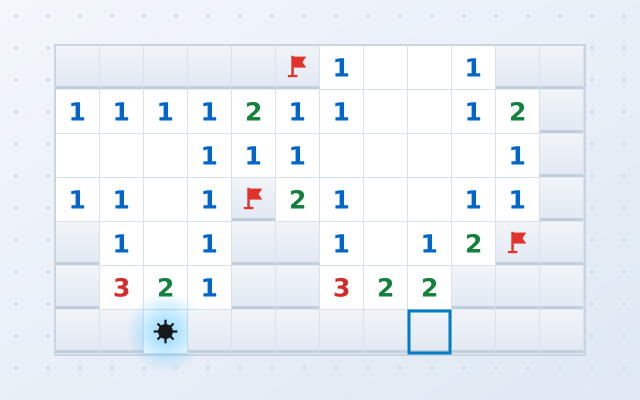
Minesweeper looks like a game of luck until you notice that the same few shapes of numbers keep turning up. Each one has a fixed answer. Learn to spot them and most of a board solves itself, leaving guesses for the rare positions where logic really cannot decide.
Every pattern below is explained from first principles, so you can work it out again if you forget it. You can practise them straight away in Minesweeper.
What a number really tells you
An open number counts the mines among the squares that touch it, diagonals included: up to eight neighbours, fewer along a wall or in a corner. Two simple deductions follow, and every pattern is built from them.
- All mines: if a number equals the count of covered squares around it, every one of those squares is a mine.
- All safe: if a number already touches that many known mines, every other covered square around it is safe.
A blank square is a 0. That is why the game opens its neighbours for you automatically.
Reduce every number by the mines you know
Before looking for a pattern, subtract the mines you have already found. A 3 that touches two known mines behaves exactly like a 1 for the squares that are still covered. Players call this the reduced, or effective, number.
Most patterns are easier to see on reduced numbers. A row reading 2-3-2 next to a line of flags often turns out to be a plain 1-2-1 once the flags are taken off.
Flags in Aback Games are notes for you and are never checked, so only subtract mines you are sure of.
The 1-1 pattern
Picture a straight line of open numbers with a line of covered squares above them. Start at a wall or at an open area, where the first 1 touches only two covered squares. Its mine must be in one of those two.
The next 1 touches those same two squares plus one more. Its single mine is already accounted for by the first pair, so the third square is safe. Open it, and the pattern often repeats along the edge.
The 1-2 pattern
Along the same kind of straight edge, take a 1 with a 2 beside it. The 1 and the 2 share two covered squares, and the 1 allows at most one mine among them.
The 2 needs two mines, but its shared squares can give it only one. So the covered square on the far side of the 2, away from the 1, must be a mine.
There is a second half. Now the shared squares hold exactly one mine, which is all the 1 needs, so the covered square on the far side of the 1 is safe.
The 1-2-1 pattern
A 1-2-1 along a straight edge is two 1-2 patterns facing each other. Read 1-2 from the left and you learn that the square across from the right-hand 1 is a mine. Read it from the right and the square across from the left-hand 1 is a mine too.
That gives the 2 its two mines, so the square straight across from the 2 is safe. In short: in 1-2-1, the mines sit across from the 1s.
The 1-2-2-1 pattern
Apply the same reasoning to 1-2-2-1. Each end gives a 1-2 pattern, and each one marks the square across from the farther 2 as a mine. The two mines sit across from the two 2s.
Both 1s are then satisfied, so the squares across from the 1s, and any further covered squares those 1s touch, are safe.
Corners, walls and holes
The edge of the board works like a row of open squares: nothing beyond it can hold a mine. That is why patterns are easiest to start from a wall or a corner. A 1 in a corner of the covered area that touches a single covered square has found its mine.
Watch for a covered square boxed in by open numbers. If any of those numbers needs exactly one more mine and that square is its only covered neighbour, it is a mine; if any of them is already satisfied, it is safe.
Count mines at the end
The Mines counter shows the total number of mines minus the flags you have placed. Near the end of a game it can decide positions the numbers cannot.
Say two separate groups of covered squares are left and you know one of them holds exactly one mine. If the counter says one mine remains, the other group is entirely safe.
When you have to guess
Boards are random, so some positions cannot be solved by logic, most often late in an Expert game. When that happens, choose the guess that is least likely to be a mine and most likely to tell you something.
- A square far from any number has roughly the board's average chance of hiding a mine: about 21% at the start of an Expert game, then whatever the remaining mines divided by the remaining covered squares works out to.
- A square next to a low number with many covered neighbours, such as a 1 touching six covered squares, is often safer than average.
- Prefer a square whose number would settle the next few squares, rather than one that leaves you guessing again.
- Leave true 50/50s until last. Solving everything else first sometimes turns them into certainties.
Play faster
Once a number has all its mines flagged, click the number itself to open every other square around it at once. This is called chording, and it is the quickest way to clear safe squares.
You never need to flag mines to win in Aback Games: the board is cleared when every safe square is open. Some fast players flag only the mines they need for chording.
Questions
What does 1-2-1 mean in Minesweeper?
It is a row of numbers 1, 2 and 1 along a straight edge of covered squares. The two mines are always across from the 1s, and the square across from the 2 is safe.
Is Minesweeper just luck?
Mostly not. The first click is always safe in Aback Games, and most of every board can be solved with the patterns above. Random boards do sometimes leave a position that needs a guess, usually near the end of a hard game.
Do I have to flag every mine to win?
No. In Aback Games you win as soon as every square without a mine is open. Flags only help you keep track and let you chord.