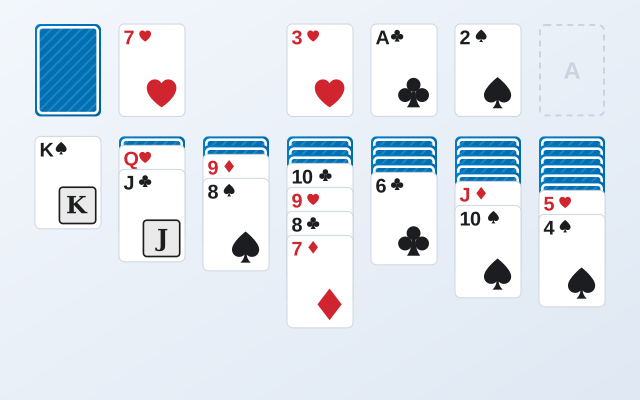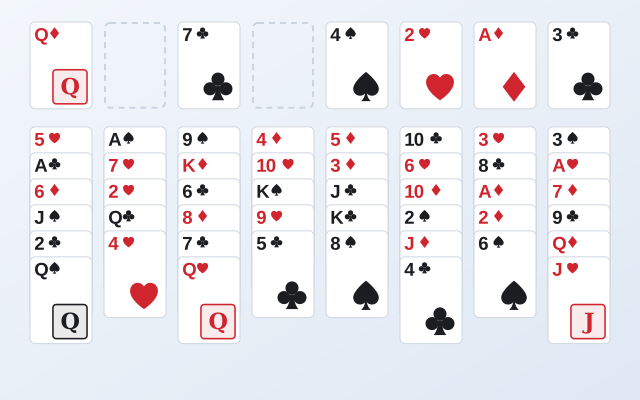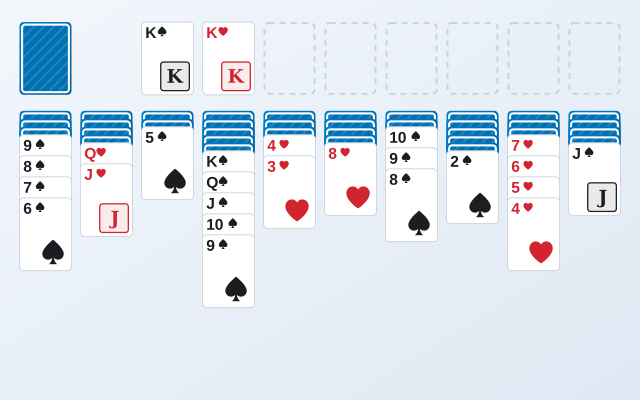
Klondike is the solitaire most people mean by the word: seven columns, a stock in the corner and four foundations to build from ace to king. Luck decides some deals, but most games are lost to small, avoidable choices rather than to the cards.
These are the habits that make the biggest difference. Try them in Solitaire, where undo and hints are always there while you learn.
Look for face-down cards first
Every face-down card is a card you cannot plan with. The single best habit is to prefer moves that turn one over. When two moves are possible, choose the one that uncovers a card.
Work on the longest columns early. The column of seven holds six hidden cards, more than any other, and the cards trapped there are the ones that end games.
Play the table before the stock
Before you turn a card from the stock, make every useful move on the table. A card drawn from the stock might be exactly what you need later, but the table can only get better while you clear it.
Then draw, and check whether the new card opens anything up before you draw again.
Empty a column only when it helps
Only a king, or a run headed by a king, can go into an empty column. Emptying a column with no king ready to fill it wastes the space and often leaves a card you needed stuck elsewhere.
When you do have a choice of kings, pick the one that frees more face-down cards, or the one whose queen of the opposite colour is easy to reach.
Be careful with the foundations
Aces and twos can always go up: nothing on the table can be placed on them. Higher cards are different. A red 6 on the table is a home for black 5s; send it to the foundation too early and a black 5 may have nowhere to go.
A simple rule: move a card up when both cards of the opposite colour one rank lower are already on the foundations, or when it frees something you need now. Aback Games lets you move a card back down from a foundation, which can rescue a game, but it is better not to need it.
Keep colours balanced
If you have a choice of two cards to move onto a run, such as two black 8s for one red 9, think about which one leaves the better card behind. The one that uncovers a face-down card, or a card you can play elsewhere, is usually right.
Draw 1 and Draw 3
With Draw 1, every stock card is reachable on every pass, so the stock behaves like a slow but complete list. Most deals are far easier.
With Draw 3, only every third card shows on each pass. Playing one card from the waste shifts the order, so cards that were hidden become reachable on the next pass. If you are stuck, a single play from the waste can change everything about the next run through the stock.
Aback Games lets you go through the stock as many times as you like in both modes, so time spent cycling it is never wasted.
Know when a deal cannot be won
Some deals cannot be won, even with perfect play: a key card can be buried under cards that need it first. If you have cycled the stock with nothing changing, and no move turns over a new card, it is time for a new deal. Starting another one costs nothing.
Questions
Can every game of solitaire be won?
No. Some Klondike deals cannot be won however you play them. Many lost games can be won with better choices, though, especially with Draw 1.
Is Draw 1 or Draw 3 easier?
Draw 1 is easier because every card in the stock is available on every pass. Draw 3 shows only every third card, which makes planning harder.
Should I always put cards on the foundations straight away?
Aces and twos, yes. Higher cards can be more useful on the table, where they give lower cards of the opposite colour somewhere to go.